Chicken Road is a fast-paced casino-style game built around simple decisions, rising multipliers, and increasing risk. The main idea is easy to understand: a chicken moves forward step by step, and each successful move can increase the potential payout. The longer the chicken continues, the higher the possible reward becomes. At the same time, every new step adds more risk.
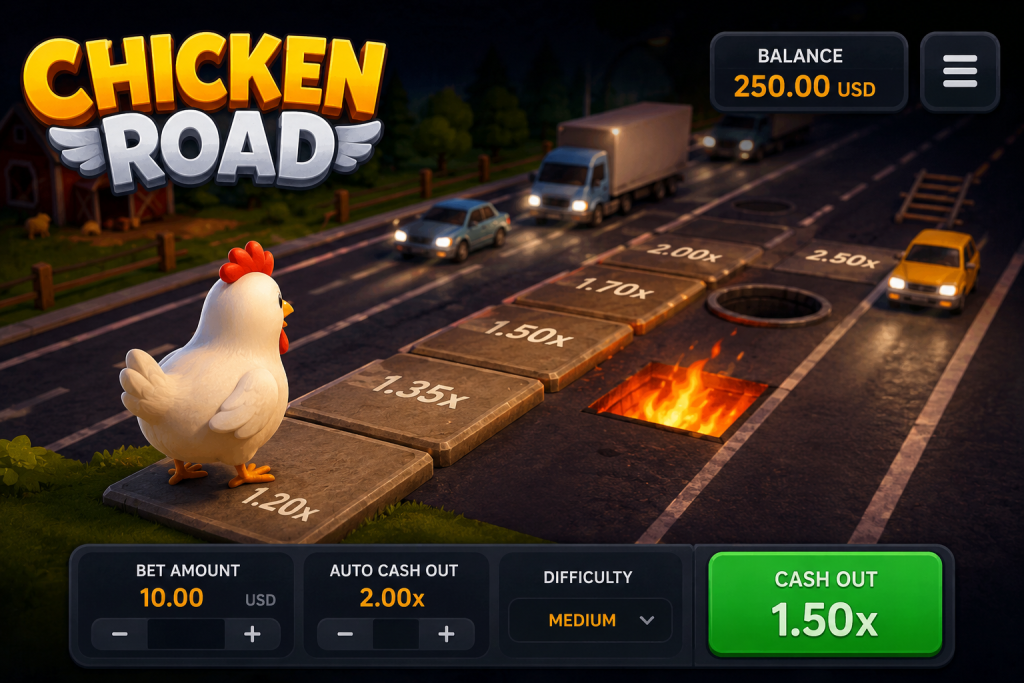
The game is popular because it does not require complex knowledge. Players do not need to study long tables, card combinations, or sports statistics. Instead, the round is based on timing, risk control, and the decision to either continue moving or stop and collect the current payout.
Main Objective of Chicken Road
The goal of Chicken Road is to move the chicken as far as possible without losing the round. Each safe step increases the multiplier. The player must decide when to cash out before the chicken reaches a dangerous point.
The basic objective can be described in three parts:
Start the round with a selected bet amount.
Move forward and increase the multiplier.
Cash out before the round ends badly.
The challenge is that the player does not know exactly how long the safe path will continue. This creates the central risk of Chicken Road: the possible payout grows, but the chance of losing the bet also grows with every move.
Basic Rules of Chicken Road
Rule 1: Choose a Bet Amount
Before the round begins, the player selects the stake. This is the amount that will be used for the round. The bet should be chosen carefully because the full stake can be lost if the player continues too far and fails to cash out in time.
A responsible approach is to avoid placing the entire balance on one round. Chicken Road can move quickly, and emotional decisions often lead to unnecessary losses.
Rule 2: Start the Round
After selecting the bet amount, the player starts the round. The chicken begins its movement along the road or path. Depending on the version of the game, the road may contain lanes, tiles, steps, cars, traps, or other danger points.
The visual style may differ from one platform to another, but the core mechanic remains similar: every successful move keeps the round alive and increases the potential payout.
Rule 3: Move Step by Step
The game usually progresses one step at a time. Each step represents a new risk. If the chicken moves safely, the multiplier increases. The player then faces a choice: stop and take the current amount or continue for a potentially higher payout.
This step-by-step structure is what makes Chicken Road simple but tense. The player is never forced to continue forever. The key decision is when to stop.
Rule 4: Watch the Multiplier
The multiplier shows how much the original stake can grow if the player cashes out successfully. For example, if the selected stake is multiplied by 2.00x, the possible return becomes twice the original bet.
The exact multiplier values depend on the version of the game, difficulty level, and platform settings. In general, the multiplier rises as the chicken moves forward. Higher multipliers usually mean higher risk.
Rule 5: Cash Out Before Losing
Cash out is the most important action in Chicken Road. If the player cashes out in time, the round ends and the current payout is secured. If the player waits too long and the chicken hits danger, the bet is lost.
The cash-out decision separates cautious play from aggressive play. Stopping early may bring a smaller result, but it also reduces risk. Continuing for a larger multiplier may bring a bigger payout, but it increases the chance of losing the stake.
How a Round Usually Works
A typical Chicken Road round follows a simple sequence:
The player selects a stake.
The round begins.
The chicken takes the first step.
The multiplier increases after a successful move.
The player chooses whether to continue or cash out.
The round continues until the player cashes out or loses.
This structure makes the game easy to follow even for beginners. However, the simplicity should not be confused with guaranteed success. Chicken Road is still a risk-based gambling game, and every round can end with a loss.
Difficulty Levels in Chicken Road
Some versions of Chicken Road may include different difficulty levels. These levels can affect how quickly the multiplier grows and how risky each step becomes.
Low Difficulty
Low difficulty usually means slower multiplier growth and lower risk per step. This option may suit players who prefer longer rounds and more cautious decisions.
Medium Difficulty
Medium difficulty creates a balance between risk and reward. The multiplier can grow faster than on low difficulty, but the danger also increases.
High Difficulty
High difficulty is usually more aggressive. The multiplier may rise quickly, but the chance of losing can also be much higher. This mode is better suited for players who understand the risk and are prepared for shorter, more volatile rounds.
Important Game Elements
The Chicken
The chicken is the main character of the game. Its movement represents the progress of the round. The farther it goes, the higher the possible reward can become.
The Road or Path
The road is the playing area. It may be shown as lanes, tiles, steps, or a crossing route. Each new part of the road represents another decision point.
The Multiplier
The multiplier is the payout growth indicator. It shows how much the stake can increase if the player stops at the current moment.
The Cash-Out Button
The cash-out button allows the player to stop the round and secure the current payout. Using it at the right moment is the main strategic decision in Chicken Road.
The Losing Point
The losing point is the danger that ends the round unsuccessfully. It may appear as a car, trap, fire tile, obstacle, or another visual element depending on the version of the game.
Manual Play and Autoplay
Some versions of Chicken Road may allow manual play, autoplay, or both.
Manual Play
In manual mode, the player controls each decision directly. The player chooses when to move forward and when to cash out. This mode gives more control but also requires more attention.
Autoplay
Autoplay allows the player to set certain conditions in advance. For example, the player may choose a target multiplier or a number of rounds. Once activated, the game follows those settings automatically.
Autoplay can be convenient, but it should be used carefully. Players should set limits before starting and avoid leaving the game running without control.
Common Mistakes in Chicken Road
Chasing the Highest Multiplier Every Round
One of the most common mistakes is trying to reach the biggest multiplier every time. This approach may look exciting, but it often leads to quick losses. Chicken Road is based on increasing risk, so pushing too far in every round is dangerous.
Betting Too Much Too Early
Large stakes can make each round more stressful. If the player loses several rounds in a row, the balance can disappear quickly. It is usually safer to keep stakes moderate and consistent.
Ignoring Cash-Out Discipline
Many players lose because they delay cashing out. They see the multiplier grow and want “one more step.” This is risky because the next step may end the round.
Playing Without Limits
Chicken Road can be fast, so it is important to set personal limits before playing. A player should decide in advance how much to spend, how long to play, and when to stop.
Simple Strategy Principles
Start with Small Bets
Small bets help players understand the game pace without risking too much. This is especially important for new users who are still learning how the rounds feel.
Use a Cash-Out Target
A cash-out target is a planned multiplier where the player stops the round. For example, a cautious player may choose to cash out early instead of waiting for a very high multiplier.
The target does not guarantee a win, but it helps reduce emotional decisions.
Do Not Increase Stakes After Every Loss
Raising the bet after a loss can be dangerous. This behavior often leads to bigger losses because it is based on emotion rather than control.
Take Breaks
Fast games can create pressure. Short breaks help players avoid impulsive decisions and keep better control over the session.
Responsible Play in Chicken Road
Chicken Road should be treated as entertainment, not as a way to earn stable income. Every round carries risk, and no strategy can remove that risk completely.
Players should remember several basic safety rules:
Only play with money that can be lost without financial pressure.
Do not chase losses.
Do not continue playing when tired or frustrated.
Set a session limit before starting.
Stop after reaching a personal limit.
The best approach is to play with discipline and understand that losing rounds are a normal part of the game.